Who Gets Remembered?
Averil Huck on Feminism, Tourism, and New Narratives
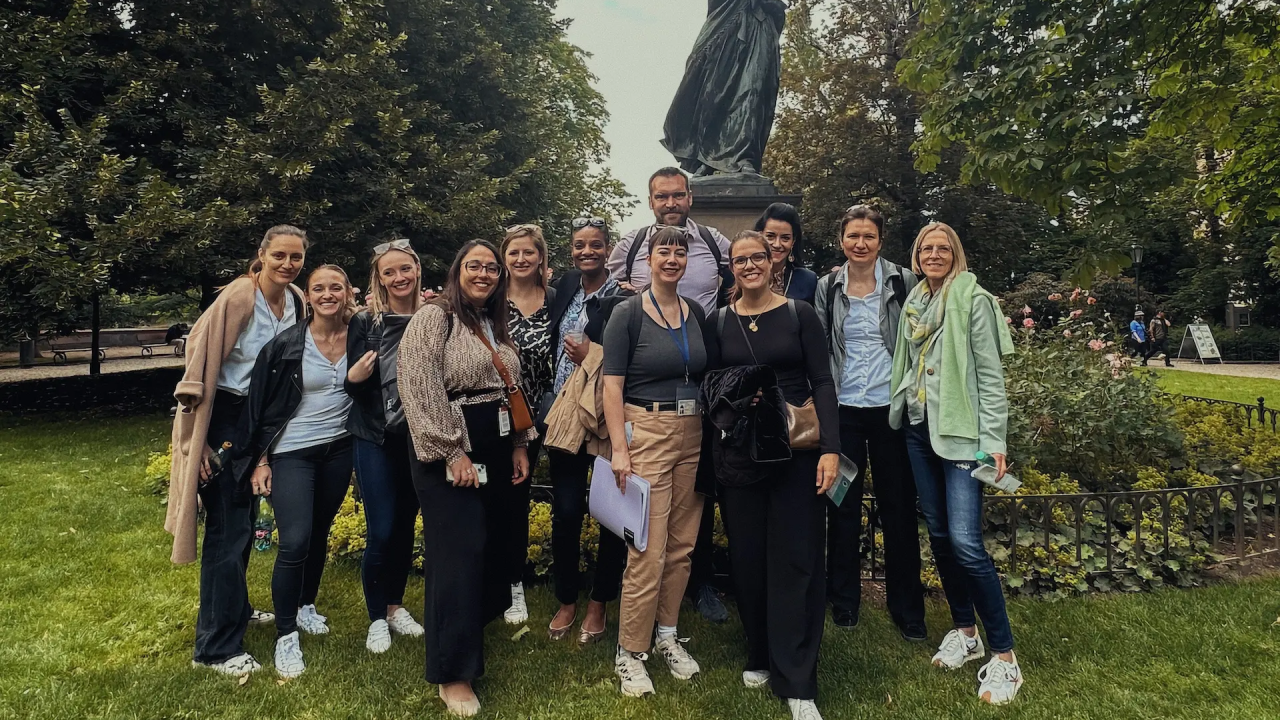
Averil Huck is the founder and guide behind Prague Feminist Tours, the first English-speaking walking tours in the Czech Republic dedicated entirely to gender equality. With a background in sociology and gender studies, and years of research experience at NKC Gender & Science, she re-reads Prague's history through feminist lenses—bringing overlooked stories, urban spaces, and women's voices back into the public narrative. Through walking, storytelling, and education, her work turns tourism into a tool for awareness and social change.
What is a feminist tour?
Hi Averil, thanks for joining us! To start, could you explain what a feminist tour actually is, and how it differs from the traditional historical or sightseeing tours many travellers are used to?
Thanks for having me! Sure, a feminist tour is both a cultural and a sightseeing experience that highlights the often-overlooked contributions of women and marginalized communities. It's a way to revisit or discover places but with a different perspective: one that challenges the traditional narrative taught at schools, in museums and the media, that focuses almost exclusively on history through the lives of "great men". We challenge who gets to be remembered.
In my case, I combine a historical, activist-oriented and intersectional approach, so participants not only learn about women's achievements but also about queer and minority experiences that have shaped Czech society.
In practice, it's still a walking tour, but we're shifting the focus from kings, war heroes and emperors to women and movements that fought for women's access to vote, work, education, to how they've contributed to building the city, society or country attendees are visiting. It's not just informative, it's a deeply reflective, immersive and community-building experience. Participants leave the tour feeling empowered and inspired, with a new perspective on history and feminism and how this relates to the public space.
From research to tourism
You have a background in gender and science research — what made you decide to adapt that expertise and passion into the tourism world, and turn it into something as hands-on as walking tours?
I've worked for three years at the Institute of Sociology at the Czech Academy of Sciences as an advocacy and research assistant on gender and science projects. That experience taught me how crucial it is to include a gender perspective in everything. Without it, we might reproduce biases and do harm.
Take something as simple as seatbelts: for decades, they were tested only on male crash dummies, which led to higher injury and death rates among women (even though they are safer drivers!). The same goes for medicine: women have been misdiagnosed for years because their symptoms weren't studied properly. Once you notice these patterns of exclusion and the "male default", you start seeing them everywhere. Even in history and tourism.
When I attended a feminist walk as a student in France, it completely clicked for me. I realised how powerful it is to revisit familiar places through a feminist lens, to see your own city come alive with stories you were never told. It planted the seed for what would later become Prague Feminist Tours.
When I started researching the tours, I saw the same patterns of invisibilisation repeating themselves. Women's contributions have been systematically erased. For instance, the beautiful glass façade of Prague's Nová Scéna theatre was designed by a couple, Jaroslava Brychtová and Stanislav Libenský. Yet, only his name appeared on Wikipedia. Luckily, one of my tour participants fixed this mistake!
Since most school curricula also overlook women's history, my tours have an educational purpose too: to fill that gap and encourage participants to think critically about whose stories get remembered, and whose don't. The amazing thing with walking tours is that they are digestible, accessible and fun: a great way to learn!
So in a way, my background in gender studies gave me the analytical tools and knowledge, but that first feminist walk gave me the passion.
Scaling feminist tours across Europe
Since that first walk, you have already managed to design four different tours in just two years of Prague Feminists Tours. Is this something specific to Prague and the Czech Republic, which have a rich history of women's emancipation and social change? What impact do you think it could have if a similar approach were adopted in more and more cities, based on the values of education and social entrepreneurship rather than mass tourism?
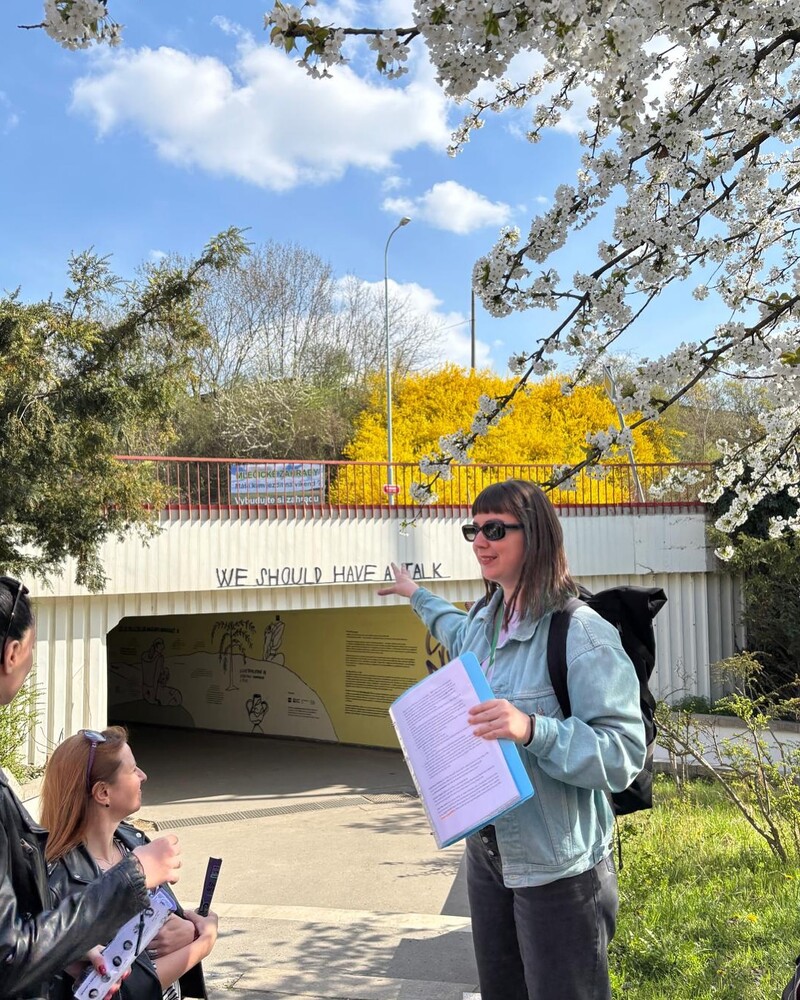
I've indeed designed four feminist walking tours plus some tailored tours on demand. Prague offers plenty of inspiration: from statues and memorial plaques to buildings and street names linked to feminist and queer history. But I don't think this is unique to Prague or to this country. Every city has untold stories waiting to be brought to life. You just need to do the research, explore archives, and walk with curiosity.
In fact, many big European cities already have women's history tours. I'm aware of at least twenty of them. Some are run by associations, others by self-employed guides like me, academics, or bigger tour agencies. It's a growing movement, but most of us operate on small scales, so our impact is still limited by capacity and visibility. But it is there.
If more cities embraced this approach, that is, putting education, social impact, and community at the centre instead of mass tourism, it could genuinely transform how we travel, how we relate to places and how we understand history.
It could also create new opportunities for local communities, especially women, LGBTQ+ people, and minorities, to reclaim their narratives, generate fair income, and participate in shaping cultural heritage. And it would benefit both international travellers and locals. Feminist tours build empathy, awareness, and civic pride. They show that there is more to the story than what we're taught at school.
So the impact wouldn't just be on tourism; it would ripple into education, social justice, and community building. If more cities adopted this model, travel could become a tool for empowerment, not just entertainment.
Balancing business and mission
Absolutely, when experiences become commodities and communities become "destinations", the transformative value of travel is lost. But in the current system, how do you balance the need to attract participants and remain commercially visible, while keeping the social and educational mission at the forefront?
Ufff, that's a great question and something I'm still navigating. Prague is a very saturated tourism market, but that also means travellers are looking for experiences that feel genuine and meaningful. The uniqueness of my tours sets them apart, so I try to embrace that by framing them as both a cultural and social experience, something that connects people to local history and values.
I've kept my prices accessible because I believe money shouldn't be a barrier to knowledge or leisure. I also collaborate with organisations that use their budgets or grants to make the tours free for their communities. That helps me stay true to my mission while keeping the project sustainable.
For visibility, I focus on storytelling, especially on social media, to explain not just what the tours are, but why they exist. When people feel the purpose behind a project, it builds trust. So yes, it's a balancing act, but one that reminds me that ethical business and social impact can absolutely coexist.
Advice for aspiring social tourism entrepreneurs
For someone who wants to start their own socially-driven tourism initiative — maybe linking a cause with a local experience — what lessons from your own path would you share?
I would say: go for it! Don't wait for the perfect timing or funding. Start small, test ideas, and let them grow organically. You'll make mistakes, but that's part of building anything.
For me, the key lesson was to keep the mission at the heart of every decision. Beyond sharing women's history, I wanted my project to actively support feminist causes, so I use my social media platform to highlight Czech NGOs doing vital work. From time to time, I also organise fundraiser tours. In 2025 alone, tour participants helped raise over 11,000 CZK (455€) for Konsent and the Abortion Support Alliance Prague.
It's also about aligning your tools with your values: I use Ticket Tailor, a B Corp–certified platform that offsets carbon emissions and donates part of each ticket sale to charity. These small choices add up.
Ultimately, socially driven tourism is about building community, not just running tours. If you stay authentic and purposeful, people will want to be part of your story and that's the most rewarding kind of growth.
A woman from Prague's history
To conclude, without giving away too many spoilers from your tours, could you share one story of a woman from Prague's history that inspires you personally — and that you hope will stay with travellers after the walk?
I'm very inspired by Františka Plamínková, like many feminists in this country. She was a teacher, politician, and women's rights activist who made deeply personal sacrifices for her beliefs. At the time, women teachers and civil servants were forced to remain single. Marriage meant immediate dismissal, so she broke off her engagement to continue her career in teaching. Her ambitions were simply greater than the role society expected of her.
Plamínková went on to dedicate her life to improving Czech women's rights. She and other feminist leaders were behind women's right to vote, maternity leave, the removal of the celibacy rule for teachers and more. But she was also a courageous member of the anti-Nazi resistance. In 1937, she wrote an open letter criticising Hitler, an act that ultimately cost her her life.
I tell her story during the tours, and it always moves people deeply. She represents the intersection of feminism, democracy, and moral courage.
And for anyone curious to learn more, the National Museum has recently opened an exhibition about her legacy, available until 31 August 2026.
"Every city has untold stories waiting to be brought to life. You just need to do the research, explore archives, and walk with curiosity."- Averil Huck
Thank you, Averil - See you soon for more tours together in Prague!